Come, lets SCALE the business together..
From Category Leader to Market Leader
What can a leader brand in a category look at to be a market leader..
Ashmeer M. Sayyed
7/21/20269 min read


From Category Leader to Market Leader:
A Playbook for India's Next Great Footwear Company
There is a specific kind of stuck that only successful companies experience.
It doesn't look like failure. The revenue line is climbing. The stock listed a few years ago at a premium. Analysts write "buy" notes. The founder's grandchildren could, if they wanted, coast.
And yet — in the boardroom, everyone knows something isn't quite adding up to the ambition. The company is unambiguously the category leader. It is not, yet, a market leader. And the gap between those two words is where this case study lives.
Over the last few months, our team at AsRaVe went deep into the public financials, retail architecture, and channel economics of one such company — a listed Indian sports and athleisure footwear brand with a multi-decade trade-distribution heritage, a professionalized leadership team brought in over the last five to seven years, and a newly minted Chief Business Officer tasked with a single, brutally simple mandate: turn category dominance into market dominance, within five years.
We're not naming the brand. What matters isn't who they are — it's the pattern. We've seen this exact inflection point in apparel, in innerwear, in beauty, and now in footwear. If you run retail strategy for a mid-cap Indian consumer brand with a strong regional or category stronghold and ambitions beyond it, this is very likely your next three to five years too.
The Problem: Winning a Segment Isn't the Same as Winning the Market
Start with the numbers that matter, stripped of anything that would identify the company.
This brand commands roughly a 17% share of its defined sub-segment — sports and athleisure footwear — making it the outright #1 domestic player in that space, ahead of every other listed competitor. Its revenue grew industry-beating ~20%+ CAGR through its high-growth years, before a deliberate one-year correction where topline actually fell by low single digits — a controlled contraction, not a collapse, that we'll come back to. Post-correction, revenue growth resumed at double digits, EBITDA margin expanded by roughly 160 basis points year-on-year, and profit-after-tax margin recovered to the mid-single-digit range, up from a dip a year prior.
Operating cash conversion — the truest test of whether a consumer business is healthy or merely growing — improved dramatically: from a conversion ratio in the high teens (as a % of profit) to well over 150–190% within three years. Debtor days fell by roughly a quarter. Inventory days improved by over 10%. Return on capital employed, after dipping through a distribution reset, climbed back into the 20%+ range.
By any conventional scorecard, this is a well-run company. So why does the leadership team — and specifically the newly elevated CBO, hired for exactly this reason — describe the next five years as the most consequential in the company's history?
Because being #1 in a ~₹12,000-15,000 crore sub-segment inside a ₹1,70,000 crore-plus total domestic footwear market (itself headed toward more than double that size within a decade, per industry estimates) means you have, at best, captured a sliver of a much larger opportunity. And the adjacent players who dominate the rest of that market — the multi-category leviathan with roughly six to seven times the store count, the asset-light premium operator running ~600 basis points higher EBITDA margins, and the global sportswear majors who own every rupee spent above the premium price threshold — are not standing still. One of them launched a direct multi-brand athletic retail concept aimed squarely at this company's home turf less than a year before our engagement began.
This is the anxiety behind the ambition. Not "are we doing well" — but "are we building the right kind of company to win the next decade, or optimizing the current one."
The Diagnosis: Three Structural Tensions
We identified three tensions sitting underneath every strategic decision this CBO would need to make. None of them are unique to footwear — we see versions of all three across apparel, innerwear, and beauty engagements at AsRaVe. But footwear makes them unusually visible because the channel economics are so starkly different from one another.
Tension 1 — The Channel Transition Trap
More than half of this company's revenue still flows through general trade and multi-brand outlet distribution — a channel that is high-volume, low-margin, and structurally resistant to premium pricing. It is also the channel that built the company over four decades and remains, by a wide margin, its most efficient volume engine in Tier 2 and Tier 3 India.
The instinct in every boardroom facing this situation is the same: shift hard toward exclusive brand outlets (EBO) and direct-to-consumer, because that's where the margin and the brand-building live. And the instinct is half right. Every global sportswear brand that succeeded in premiumizing did so by building owned retail. But nearly every one of them also stumbled badly on the way — starving trade partners of stock and mind-share, triggering channel conflict, and losing volume faster than owned retail could replace it.
The mandate, correctly, is not "replace trade distribution." It's "grow direct channels at a rate meaningfully faster than trade, without ever letting trade feel abandoned." That's a sequencing and communication problem as much as a strategic one — and it's the single most common way we've seen ambitious retail transformations fail even when the underlying strategy was sound.
Tension 2 — The Premiumization Squeeze
This company's core customer lives in a well-defined price band — roughly the equivalent of a mid-market sweet spot that currently represents over 40% of total revenue. The strategic ambition is to push blended average selling price up by roughly 20-25% over three years. The risk is straightforward and unforgiving: move too fast, and you alienate the value-conscious buyer who made you #1 in the first place, without yet having built enough credibility to pull in the premium buyer currently loyal to global sportswear giants.
We think of this as threading a needle with two different colours of thread at once. You cannot out-premium the premium players in years one or two. What you can do is expand the "good-better-best" ladder within your existing customer base — giving your existing buyer a credible reason to trade up 15-20%, while reserving genuine premium credibility (better materials, in-house technical manufacturing, flagship retail environments) as a multi-year build, not a marketing campaign.
Tension 3 — The Geography and Demographic Whitespace
This is the quieter tension, and in our experience, the most expensive one to ignore. The brand over indexes heavily in North and Central India — its historical trade-distribution stronghold — and under indexes badly in the South and West, which happen to be exactly where its two most formidable competitors (the multi-category chain and the premium asset-light operator) are strongest. Meanwhile, the women's and kids' categories sit at a combined ~20% of revenue mix, well below what a mature, balanced footwear portfolio should look like — and well below where the company's own leadership wants it within five years.
Geography and demographics compound each other here: the South and West skew more urban, more brand-conscious, and — not coincidentally — represent the highest-potential markets for the women's category specifically. Solve one, and you materially help the other.
Segment-by-Segment: Where the Five-Year Battle Actually Gets Won or Lost
Here is where we get concrete. A five-year strategy that stays at the "premiumize and expand" altitude is not a strategy — it's a slogan. Below is how we'd break the mandate down by segment, because each one has a genuinely different playbook.
Men's Footwear
(the largest single category, well over 40% of revenue). This is the fortress to defend, not the frontier to conquer. The play here is quiet margin expansion — better materials, in-house technical manufacturing for running and sports sub-categories, and disciplined SKU rationalization — while resisting the temptation to chase every trend. A fortress that gets neglected while everyone chases growth elsewhere stops funding the growth elsewhere.
Women's Footwear
(roughly 12% of revenue today, targeted to reach 15%+ within two years and materially higher by year five). This is the single highest-leverage segment in the entire portfolio, because it is simultaneously underpenetrated, high-growth industry-wide, and directly additive to the geographic whitespace problem above. It deserves its own design language, its own retail fixtures within EBOs, and — critically — brand ambassador and marketing spend disproportionate to its current revenue share, because you are not defending share here, you are creating category awareness from a low base.
Kids' Footwear
(~8% of revenue). Structurally important but not where the five-year battle is won. The right posture is efficient category maintenance — leverage the parent brand's trust, keep the category profitable, and don't over-invest management bandwidth here relative to its ceiling.
Athleisure Apparel — The Genuine Wildcard
This deserves its own section, because it's the one call in this entire strategy that could go either way, and we think leadership is right to be nervous about it.
The case for it as an opportunity: Apparel meaningfully lifts basket value and store productivity — the same customer who buys shoes now has a reason to buy a T-shirt and track pants in the same visit, turning single-category footfall into a multi-category transaction. It also extends brand relevance into a category with structurally higher repeat-purchase frequency than footwear. Every large global sportswear brand's economics ultimately rest on apparel and footwear working together, not footwear alone.
The case for it as a risk: This company has zero manufacturing heritage, zero supply chain muscle, and zero consumer credibility in apparel. It is being piloted in a small subset of stores for a reason — a full-scale launch before the pilot proves basket-lift and repeat-purchase economics would be a classic case of over-extending a strong brand into a category where a mediocre execution actively damages the core footwear equity, rather than merely underperforming quietly.
Our verdict: Treat this as a measured, metrics-gated expansion, not a strategic pillar — at least through year three. Define two or three hard numbers upfront (basket attach rate, apparel-driven footfall, repeat purchase within 90 days) and let the pilot data — not enthusiasm, not competitive pressure — decide the scale-up pace. If those numbers hold, apparel becomes a genuine second engine by year four or five. If they don't, a small, profitable apparel counter inside select flagship EBOs is a perfectly fine permanent outcome — this doesn't have to become a standalone business to have been worth doing.
International
(nascent, low single-digit % of revenue currently). Right now, this is optionality, not strategy — early export tie-ups in a couple of adjacent markets, own-brand, asset-light. The correct five-year posture is to let it compound quietly in the background without diverting management bandwidth from the much larger domestic prize. By year five, this should be a meaningful growth vector, but it should never have been the point of any given year's plan.
Digital / D2C and Quick Commerce
This is genuinely the strongest card in the hand — clear online marketplace leadership, credible presence across major platforms, quick-commerce distribution live and scaling, and modern ERP infrastructure already implemented. The five-year task here isn't building capability, it's building margin — shifting mix from marketplace-dependent volume (with its commission drag) toward owned brand.com and app-based direct sales, where full-price realization and first-party consumer data both live.
EBO Network and Modern Retail — the Strategic Battleground
Store count needs to roughly grow 65-70% over the five-year window, but the more important number is the mix shift toward higher-quality, company-operated formats in premium urban geographies, specifically to close the South and West gap identified above. This is capital-intensive and slow — averaging 30-36 months for a store to mature — which is exactly why it needs to start on Day One of Year One, not Year Three.
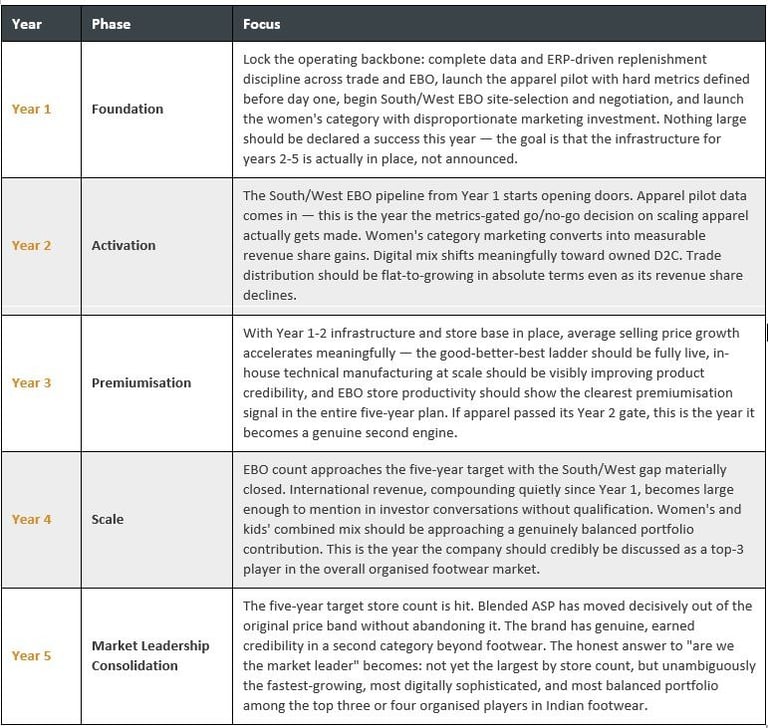
The Five-Year Roadmap: Four Distinct Phases
We don't believe in five-year plans that repeat the same priorities five times with bigger numbers. Each year needs a genuinely different centre of gravity.
The Verdict
Here's the uncomfortable truth we'd give this CBO directly, and the one we give most clients standing at this exact inflection point: the building blocks are almost never the constraint. Sequencing discipline is.
This company has the manufacturing base, the balance sheet (debt levels are healthy, cash conversion is strong, and the leadership bench has been deliberately built with both trade-distribution veterans and category-specific talent from established consumer and sportswear companies), and the market tailwind — a footwear industry growing faster than GDP, an organised-retail share still expanding from roughly a third of the market toward global norms, and a domestic consumer trading up faster than at almost any point in the last two decades.
What determines whether this becomes a genuine market-leadership story or a well-run niche player that plateaued is not any single big bet. It's whether the CBO's team has the discipline to run Year 1 as Year 1 — building unglamorous infrastructure — instead of skipping straight to the premiumisation headlines that look better in a board deck. Every failed retail transformation we've studied at AsRaVe failed for this reason, not for lack of strategic clarity.
Category leadership is a starting position. Market leadership is a five-year execution habit. The gap between them is exactly as wide as the discipline to run Year-1 like Year 1.
AsRaVe works with legacy and D2C consumer brands building or scaling offline retail — EBO networks, franchise (FOFO/FOCO) execution, general trade and modern trade distribution strategy. If your leadership team is navigating this same category-leader-to-market-leader inflection point, we'd like to talk. Reach us at asrave.in.
Office
14/2, Sarjapur Road, Bengaluru, 560035